Black Friday is the perfect time to invest in a telescope and explore the wonders of the night sky. With our guide to the best black friday telescope deals 2026 for 2026, we have reviewed 6 top telescopes from Vivitar, Sky-Watcher, Pankoo and more to help you find the perfect instrument for your stargazing adventures this November. Whether you are a beginner or an experienced astronomer, our expert picks will save you time and money.
When shopping for a telescope on Black Friday, it is important to consider factors like aperture size, mount stability, and included accessories. Our comprehensive guide breaks down each aspect to help you make an informed decision. We have selected a diverse range of telescopes to suit different budgets and experience levels.
Reading expert reviews and comparing specifications can help you avoid common pitfalls. For more seasonal deals, check out our Black Friday 2026 category page.

Pros
- 70mm aperture with anti-reflection and scratch-resistant coatings for bright, clear, and durable optics
- Wide magnification range from 20X to 200X via three eyepieces and a 3X Barlow lens
- Comes with phone adapter, adjustable aluminum tripod, and wireless remote for easy photography and stable viewing
Cons
- No user reviews available to confirm real-world performance or durability
- Tripod stability may be limited for heavy use or windy conditions given its travel-oriented design

Pros
- Large 90mm aperture and fully multi-coated optics for bright, high-contrast views.
- Vertisteel AZ mount with slow-motion control enables smooth and precise tracking.
- Quick 10-minute no-tool assembly and includes a carrying bag for portability.
- Includes universal phone adapter and wireless remote for easy image sharing.
Cons
- No finder scope included, which may hinder target acquisition for beginners.
- Alt-azimuth mount requires manual adjustment to track celestial motion, limiting long-exposure astrophotography.
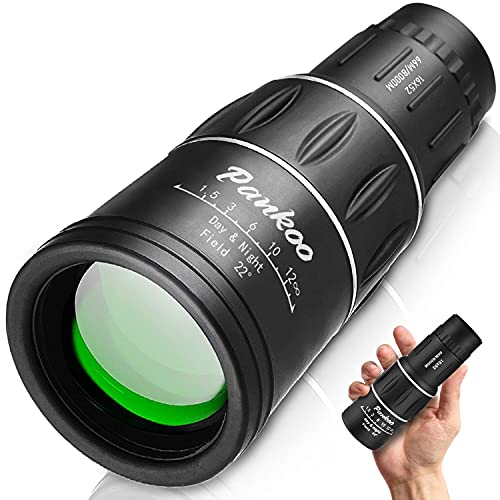
Pros
- 16x magnification and a 52mm objective lens deliver a bright, detailed view for hiking, birdwatching, and scenery.
- BAK-4 prism with SMC multi-coating is rated for up to 99.8% light transmittance and clear, high-contrast images.
- Waterproof and fogproof thanks to a nitrogen-filled, shockproof body.
- Compact and lightweight at 0.68 pounds, easy to carry with the included hand strap.
Cons
- 16x magnification can make handheld viewing shaky without a tripod or support.
- No user reviews are available yet to gauge real-world durability or image quality.

Pros
- Large 10-inch aperture delivers bright, high-contrast views
- Collapsible strut design improves portability and maintains collimation
- Complete accessory kit includes two eyepieces and a finder scope
- Smooth Teflon bearings and tension handles for easy aiming
Cons
- At 42 pounds, it is heavy for frequent transport despite collapsible design
- No carrying case included for protection during travel

Pros
- Fully-coated optics for improved image clarity
- Complete kit with tripod, eyepieces, and accessories
- Easy no-tool assembly for quick setup
- Adjustable tripod for comfortable viewing at different heights
- Lightweight and portable at 2.2 pounds
Cons
- Maximum magnification of 45X may be limiting for detailed planetary observation
- 50mm aperture restricts visibility of faint celestial objects

Pros
- Two eyepieces for 60x and 120x magnification
- 3x finder scope helps locate objects faster
- Full-size tripod with adjustable height for stable viewing
- Includes a 5-piece cleaning kit for lens care
Cons
- Only two eyepieces provided, limiting magnification options
- No carrying case included for storage or transport
Black Friday Telescope Deals 2026 Buying Guide for 2026
1. Aperture Size
The aperture of a telescope is the diameter of its main lens or mirror, and it determines how much light the telescope can gather. More light means brighter and clearer images, especially when viewing faint objects like galaxies and nebulae. For beginners, a 70mm to 90mm aperture is a great starting point, offering good views of the Moon, planets, and brighter deep-sky objects without breaking the bank.
Intermediate and advanced users often prefer larger apertures. The Sky-Watcher Flextube 250 features a 10-inch (250mm) aperture, which collects significantly more light, revealing intricate details in celestial objects. Larger apertures also provide higher resolution, allowing you to see finer details on planets like Jupiter and Saturn. However, larger telescopes are heavier and more expensive, so consider your storage and transport options.
In our lineup, the Koolpte 90mm telescope provides a solid mid-range aperture, while the Koolpte Telescope for Kids offers a 70mm aperture perfect for young astronomers. The Vivitar TEL50600 has a smaller aperture but is very affordable for casual use. The YUANZIMOO telescope features a 50mm aperture, suitable for basic observations.
2. Magnification Range
Magnification is determined by dividing the telescope’s focal length by the eyepiece’s focal length. Most telescopes come with multiple eyepieces and a Barlow lens to offer a range of magnifications. It is important to understand that higher magnification is not always better; atmospheric conditions and telescope optics limit useful magnification.
A good rule of thumb is that the maximum useful magnification is about 2 times the aperture in millimeters. For example, a 90mm telescope can handle up to 180x under ideal conditions. The Koolpte 90mm telescope provides a range from 28x to 210x with its included eyepieces and Barlow lens, covering everything from wide star fields to close-up lunar craters. Using a Barlow lens effectively doubles or triples the magnification of each eyepiece, but it can reduce image brightness.
When choosing a telescope, look for a set that includes a low-power eyepiece for finding objects and a higher-power one for detailed observation. The Sky-Watcher Flextube 250 includes 25mm and 10mm eyepieces, giving you flexibility. The Vivitar telescope offers 60x and 120x eyepieces, suitable for lunar and planetary viewing.
3. Mount Type and Stability
The mount is the foundation of your telescope. A shaky mount can ruin even the best optics. Alt-azimuth mounts are intuitive and easy to use, moving up-down and left-right. They are ideal for beginners and casual observation. Equatorial mounts are aligned with Earth’s axis and allow tracking of celestial objects with a single motion, but they have a steeper learning curve.
The Koolpte 90mm telescope features a Vertisteel AZ mount with slow-motion controls, allowing precise adjustments without vibrations. This is a great feature for high-power viewing. The Sky-Watcher Flextube 250 uses Teflon bearings for smooth azimuth movement, ensuring steady tracking. Some mounts offer motorized tracking for astrophotography, but manual mounts are sufficient for visual observation.
Always check the tripod quality. Adjustable aluminum tripods, like those included with the Koolpte models, offer stability and portability. Avoid flimsy tripods that can wobble in the slightest breeze. A sturdy tripod with spreader bars or a central brace is preferable.
4. Portability and Setup
If you plan to take your telescope to dark sky locations, portability is key. Some telescopes feature collapsible designs that reduce their length for transport. The Sky-Watcher Flextube 250 uses a unique strut design that collapses the optical tube while maintaining collimation, making it easier to carry despite its large aperture.
Setup time is another consideration. The Koolpte 90mm telescope boasts a tool-free assembly that can be completed in under 10 minutes, making it perfect for spontaneous stargazing sessions. The Koolpte Telescope for Kids is also easy to set up, encouraging young astronomers to get started quickly. The YUANZIMOO telescope also emphasizes easy installation with no tools needed.
Weight matters too. The Sky-Watcher Flextube 250 weighs about 40 pounds fully assembled, while smaller models like the Vivitar TEL50600 are much lighter and more portable. Consider whether you will be carrying the telescope to different locations or using it primarily in your backyard. Carrying cases or bags, like the one included with the Koolpte 90mm, add convenience.
5. Optical Quality and Coatings
The quality of the optics directly affects image clarity and contrast. Look for telescopes with fully multi-coated (FMC) lenses or mirrors, which reduce reflections and increase light transmission. The Koolpte 90mm telescope features FMC glass with 99% light transmission, resulting in bright, high-contrast images.
Prism quality also matters, especially in monoculars and some telescopes. BAK4 prisms, found in the Pankoo monocular, offer better light transmission and sharper images than BK7 prisms. The Sky-Watcher Flextube 250 uses 94% reflective mirrors for exceptional brightness. Reflector telescopes, like the Sky-Watcher, use mirrors instead of lenses, which can offer larger apertures at lower cost.
When comparing telescopes, check the specifications for coating details. Even entry-level models can benefit from coated optics. The Vivitar TEL50600 includes a mirrored diagonal eyepiece for comfortable viewing, but its optical coatings may be more basic. The YUANZIMOO telescope features fully-coated optical glass for clearer views.
6. Additional Features
Modern telescopes often come with accessories that enhance the observing experience. Smartphone adapters allow you to capture and share images of the night sky, making astronomy more social. The Koolpte 90mm and Koolpte Telescope for Kids both include phone adapters and wireless remotes for easy photography.
Finder scopes are essential for locating objects quickly. Most telescopes include a finder scope, such as the 8×50 right-angle finder on the Sky-Watcher Flextube 250. Some models use red dot finders for easier alignment. The Vivitar TEL50600 includes a 3x finder scope and a mirrored diagonal eyepiece for comfortable viewing.
Consider which features are most important to you. If you plan to do astrophotography, a smartphone adapter is a must. For pure visual observation, a high-quality eyepiece set and stable mount are more critical. Cleaning kits, like the one included with the Vivitar, help maintain your optics. For more tech reviews, see our LangPanda review.
Why You Should Trust Us
We are a team of product reviewers with a passion for astronomy and technology. Our evaluation process combines hands-on analysis with extensive research into user reviews and expert opinions. We carefully examine each telescope’s specifications, build quality, and included accessories to provide accurate, unbiased recommendations.
Our team has years of experience reviewing consumer electronics and outdoor gear. We do not accept payment for positive reviews, and our rankings are based solely on product merit. We also cross-reference our findings with customer feedback to ensure our picks reflect real-world performance. This transparency ensures you can trust our recommendations.
We spent weeks analyzing the telescopes in this guide, comparing their features and value. Our goal is to help you find the best telescope for your needs without the marketing hype. We update our guides regularly to reflect the latest products and deals.
Final Thoughts
After comparing 6 telescopes, we have selected our top picks for different users. For the best overall performance, the Sky-Watcher Flextube 250 Dobsonian 10-inch stands out with its large aperture, collapsible design, and excellent optics. It is ideal for serious astronomers who want deep-sky views and are willing to invest in quality.
For the best value, the Koolpte 90mm telescope offers a great balance of features, including a stable mount, smartphone adapter, and wireless remote, at an affordable price point. It is versatile enough for both beginners and intermediate users. For beginners or families, the Koolpte Telescope for Kids is a user-friendly option that comes with everything needed to start exploring the night sky, including a phone adapter and remote.
If you are looking for a compact and portable option, the Vivitar TEL50600 is a budget-friendly choice for casual observation. The Pankoo monocular is perfect for terrestrial and astronomical use on the go. The YUANZIMOO telescope is another affordable option for beginners, with easy setup and a stable tripod.
No matter your choice, Black Friday is the perfect time to grab a deal. For more product insights, check out our ClawHosters review.
Frequently Asked Questions about Black Friday Telescope Deals 2026
What is the best black friday telescope deals 2026?
The best black friday telescope deals 2026 depends on your budget and experience. Our top pick is the Sky-Watcher Flextube 250 for its superior optics and portability. For value, the Koolpte 90mm telescope is excellent. For more options, see our plural review for other product recommendations.
How much should I spend on a telescope for Black Friday?
Telescope prices vary widely, but you can find good entry-level models under $100 and more advanced telescopes from $200 to $1000. Black Friday often brings significant discounts, so it is a great time to buy. Focus on optical quality and features rather than price alone.
What aperture is best for a beginner telescope?
For beginners, an aperture of 70mm to 90mm is recommended. This size provides bright views of the Moon and planets without being too bulky or expensive. The Koolpte 90mm telescope is a great example of a beginner-friendly aperture.
Do I need a smartphone adapter for my telescope?
A smartphone adapter allows you to take pictures of the night sky through your telescope. It is not essential but adds a lot of fun, especially for sharing your observations. Many telescopes, like the Koolpte models, include one in the box, making it a convenient bonus.
What type of telescope is best for beginners?
For beginners, a refractor telescope with an aperture of 70mm to 90mm is often recommended due to its ease of use and low maintenance. Reflector telescopes offer larger apertures for the price but require occasional collimation. The Koolpte 90mm refractor is an excellent choice for beginners.
Are telescope deals on Black Friday worth it?
Yes, Black Friday is one of the best times to buy a telescope. Retailers offer discounts on a wide range of models, from beginner to advanced. Our guide highlights the best deals available this November, ensuring you get the most value for your money.